top of page

Research Blog

Search
  • Writer: Chaitanya Ambike
    Chaitanya Ambike
  • Apr 1, 2022
  • 2 min read

Updated: Apr 2, 2022

What is a Genetic Disorder? Every 6 out of 10 people have health problems associated with genetic mutations. Genetic disorders occur when a mutation affects your genes or when you have an insufficient amount of genetic material. Genes are made of DNA (deoxyribonucleic acid), which contains the instructions for cell functions as well as the characteristics that distinguish you from everybody else.

As we know humans receive half of their genes from each of their biological parents and sometimes may inherit a gene mutation from one or both. Sometimes genes change as a result of problems within the DNA. This increases your chances of inheriting a genetic disorder. Some of these disorders can cause symptoms from birth, while others develop over time. Although there are many such disorders, today, we will attempt at familiarizing you with one particular one: Thalassemia.


What is Thalassemia and what are its symptoms? Red blood cells as we know carry oxygen throughout the body; hemoglobin is a protein found in red blood cells that transports the oxygen. Thalassemia refers to a group of conditions that impair the body's ability to produce a normal amount of hemoglobin. It often causes severe anemia and other complications that occur over time. The symptoms include fatigue, weakness, pale or yellowish skin, bone deformities, abdominal swelling, dark urine, and delayed growth and development.


What are the types of Thalassemia? Hemoglobin is made up of four protein chains — 2 alpha-globin and 2 beta-globin chains. As a result, we can differentiate thalassemia into 2 major types named after the defects that can occur in these protein chains:

1. Alpha-thalassemia: Four genes (i.e. 2 from each parent) are required to make one alpha globin protein chain. When one or more genes are missing, it causes alpha thalassemia.

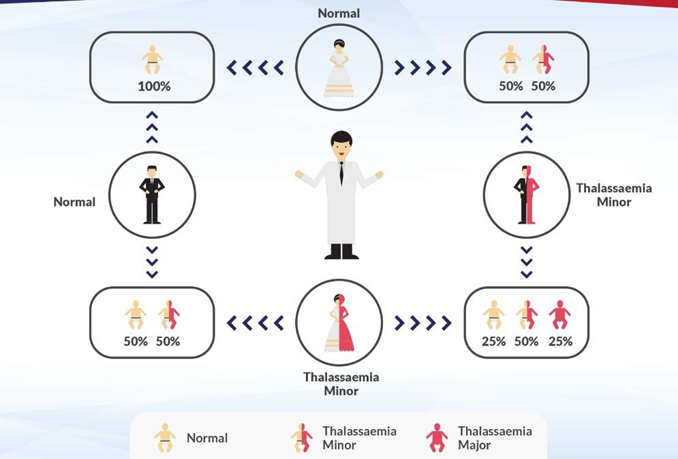
2. Beta-thalassemia: There are normally 2 beta-globin genes (i.e. one from each parent)

. Beta thalassemia is caused when a mutation occurs in one or both of the beta-globin genes.
ree

How is Thalassemia treated? Symptoms of thalassemia occur in infants when they are 6 to 24 months old. Standard treatment for this disorder is blood transfusion and iron chelation. The former includes inserting red blood cells into the body through a vein, every 4 months in alpha thalassemia patients and 2 to 4 weeks in beta-thalassemia patients. This is done in order to restore a normal level of hemoglobin. In turn, frequent blood transfusions can cause iron overload, which is extremely dangerous. Hence, the patients who receive frequent blood transfusions also require iron chelation. This involves the removal of iron from the body, which is usually done by taking pills. Bone marrow or stem cell transplant from a compatible donor can eliminate the need for lifelong blood transfusion. Are Genetic Disorders Treatable? Including thalassemia, most genetic disorders cannot be cured or prevented because it involves genes that we inherit. But in recent times with help of advanced technology, more than 600 genetic disorders have now become treatable. BIBLIOGRAPHY:

Genetic conditions (healthywa.wa.gov.au) Written by: Amizhthini and Dhwaani

  • Writer: Chaitanya Ambike
    Chaitanya Ambike
  • Mar 25, 2022
  • 2 min read

Updated: Apr 2, 2022


Have you ever wondered how we humans can alter our defining characteristics as per individual liking or eliminate genetic combinations that are the root cause of incurable, life-threatening diseases? Well, what once felt like fiction of mind is now emerging as a revolutionary, blooming technology named CRISPR. A gene-editing tool allowing scientists to simply transmute DNA sequences and modify gene function, it has a myriad of potential applications, including correcting genetic defects, treating and averting the spread of diseases, and improving the growth and immunity of crops.


Several diseases coming under the umbrella of genetic disorders are caused by an abnormality in an individual’s genetic makeup. The genetic abnormality can range from minuscule to major -- from an isolated mutation in a single base within the DNA of a single gene to a whole chromosomal abnormality which may even lead to the addition or subtraction of an entire chromosome.


The factor that adds to the severity of such disorders is that these are generally irremediable and can’t be cured by any pharmaceutical medications, in such cases the CRISPR genome editing technology comes to the rescue of such patients. It has particularly made several recent advances in the treatment of genetic blood disorders like beta-thalassemia and sickle cell anemia.

ree

Focusing our attention on sickle cell anemia (also referred to as SCD-Sickle Cell Disease) we learn that the conventional treatment procedures solely addressed the symptoms and didn’t provide any lasting, persistent cure. However, CRISPR-Cas9 has demonstrated an immense potential to cure the underlying genetic cause of the disease. A new gene therapy, CTX001 has been licensed by Vertex pharmaceuticals along with CRISPR Therapeutics. Patient data from its clinical trials have shown promising results in patients. Victoria Gray was the first person to be treated for SCD using this therapy and in July 2020 it was announced that her disease had shown significant improvement with fetal hemoglobin levels shooting up and bouts of pain disappearing. More significantly, the technology liberated her from the need of undergoing periodic blood transfusions. Despite the strides it has made in the medical field, CRISPR still has a long way to go.


Evaluating the safety and efficacy of the CTX001 in patients is key to gaining the trust of more patients who are reluctant to receive gene-editing treatments.


Along with genetic disorders, the CRISPR technology has also emerged as a ray of hope for patients suffering from cancer, Alzheimer’s disease, HIV, autism, muscular dystrophy, and inherited eye disorders, heralding the advent of the era of transformative medicine.


Bibliography

  • Writer: Chaitanya Ambike
    Chaitanya Ambike
  • Mar 20, 2022
  • 3 min read

Updated: Apr 2, 2022


Epigenetics

ree

The word ‘epigenetic’ first emerged when the validity of the thought that genes are permanent and ‘set in stones’ was questioned. Genes are the essential and physical and functional units of heredity and for a protracted time considered to be unalterable in most cases. However, this belief poses a question- why do identical twins, who have the precise same set of DNA, often find themselves extremely different from one another, both in terms of personality and in other factors which are solely hooked into genes (such as health). This is often where the term ‘epigenetic’ rises from.


What is Epigenetics? The study of how the cells can control their gene activity is known as epigenetics. In simpler words, the term epigenetics refers to the thought of how the environment an individual is raised in affects organic phenomena (gene expression) within the individual. Epigenetics is the study of how your behaviors and environment can cause changes that affect the way your genes work. The literal meaning of the word ‘epigenetic’ is “in addition to changes in genetic sequence.” Over the years, through various studies and research, the term has been further developed to incorporate any

altering of the gene, without a change to the DNA sequence.


What are the processes Involved in Epigenetics? There are three main epigenetic processes:

1. DNA methylation: The primary process- DNA methylation occurs when a covalent attachment of an alkyl and therefore the C5 position of a cytosine comprises the most epigenetic changes that occur to the DNA. This modification will be seen within the CpG dinucleotide-containing regions, which are regularly found in suppressed organic phenomena. This CpG methylation is incredibly important for tissue-restricted organic phenomena and other such processes. However, the CpG methylation not occur, and instead, the methylation of the cytosines occurring instead help for the regulation of organic phenomenon within the embryonic stem cells. These embryonic stem cells are cells capable of giving rise to many different cell types and are derived from the inner cell mass of a blastocyst at an early-stage pre-implantation embryo.


2. Histone modification: The second essential process of epigenetics is histone modification. They're an awfully important epigenetic regulator that controls the structure of chromatins, gene transcription and this causes a change within the cellular phenotypes of various cells. Over several years, several studies have shown that there are several prominent factors thanks to histone modification as a large impact on the aging process. It's also been suggested that the surplus amount and localization of those modifications cause reactions to several changes within the environment, diet, and life.


3. Noncoding RNA action: The non-coding RNA action is an important mechanism of epigenetics that regulates gene expressions and it plays a huge role in the growth and working of the brain. It is involved in the pathogenesis of psychiatric disorders and most research on the role of ncRNAs disorders is mostly focused on miRNAs. But no complete conclusion can be found regarding the role of these ncRNAs in the pathogenesis of psychiatric disorders.


To sum up, what epigenetics means we can say it is when changes occur due to age, both as part of normal development and aging and in response to your behaviors and environment.


Bibliography:

1. https://www.cdc.gov/genomics/disease/epigenetics.htm

2. https://developingchild.harvard.edu/resources/what-is-epigenetics-and-ho w-does-it-relate-to-child- development/

3. https://www.ncbi.nlm.nih.gov/pmc/articles/PMC1392256/

4. https://www.ncbi.nlm.nih.gov/pmc/articles/PMC4070783/

5. https://www.sciencedirect.com/topics/biochemistry-genetics-and-molecular-biology/non-coding-rna

6. https://www.frontiersin.org/articles/10.3389/fgene.2019.00192/full Written by: Yukta and Sarah

2

Contact
Information

GIIS Genetics Club

27 Punggol Field Walk, Singapore 828649

  • Instagram
giis_genetics_club

©2023 by Genetics Club: GIIS. Proudly created with Wix.com

bottom of page